Controllers I would say are one of the most important asset when it comes to gaming. The controller is what bonds the player to the game. With just a simple hit of a button or movement of a joystick, a choice is made and that choice is then sent into the console as a piece of data and the game then interprets it.
Without a controller the essence of play is not executed and what is a game without play? it wouldn't be a game. It would be a series of moving images and animations with no interaction.
Through the generations Controllers have gotten smaller and smaller the extent where there is no controller, instead the player is the controller. So the link is still there its just been manipulated so a players arms, legs, movements etc work as buttons to control the game through image input, for example a camera; something that captures a player in real 3 dimensional space. This bring the player closer to the game, makes it feel more real and even more believe because of the heightened sense of interactivity.
the present generation of gaming has brought the Kinect and the Playstation Move. These are the two most advanced pieces of equipment when it comes to motion capture gaming.
The Playstation Move having two hand held wireless controllers to act as motion beacons in a player's hands, in which the Playstation Eye (camera) can pick up movements and choices made by the player which are then calculated as interactions and performed on the game played.
The two controllers are also manipulated into asset of which the game provides, for example if a player is playing a archery game. One controller would be the hand that holds the bows handle and the other would be as if a arrow is being set and pulled back ready to fire.
So the illusion of the controller blending with the interaction of the game makes the player think they are actually firing a arrow from a bow.
Sunday, 4 March 2012

Thursday, 1 March 2012
Sony hardware key moments
The piece of hardware that started Sony Computer Entertainment was indeed the 'PlayStation'. The PlayStation was released in Japan on December 4th, 1994 and later in North America on September 9th, 1995. Current the highest selling console of all time.
In the year 2000 the PlayStation 2 was released which was powered by a proprietary central processing unit, the Emotion Engine and was the first game console to ever have DVD playback included.
Finally the latest Sony games console of the seventh-generation of gaming machines is the PlayStation 3, which was launched in November 2006 and is currently the most powerful console to date.
I did some research and found a article on eurogamer.net that explains in rough context why the PS3 is the most power console.
PS3 is most powerful - Hirai
Anything else "is not true".
Ignoring the howls of anguish emanating from his public relations department, Sony president Kaz Hirai has been saying things again - and guess what? He reckons PS3 is the most powerful games console, that Blu-ray is ace, and that Sony is amazing.
"I have heard many people say our competitors' systems are just as powerful as the PS3. That simply is not true," he told a CES trade rag, in comments picked up on by IGN. "No other next generation entertainment system pushes the envelope on advanced technology like PS3."
He goes on to declare that you "just can't expect that 9GBs of storage capacity found on today's DVDs are going to have enough space to hold tomorrow's games," adding that Resistance: Fall of Man's 16GBs "simply wouldn't be possible on any other system without using multiple discs". To be fair, he was talking to "Blu-ray Today".
He also reckons no one could have foreseen the problems of blue laser diode production for PS3. "I suppose if we had simply done a mild upgrade to the PS2 and not pushed the envelope so hard, it would have been easier on ourselves," he noted, pensively. "However, if we did that every time, we wouldn't be Sony."
Oh Kaaaaaz.____________________________________________________________________
I actually agree, even though I am a Microsoft user I still agree exactly what this guy is saying, if Sony didn't drive towards something new then we wouldn't have Blu-ray for example.
Blu-ray has evolved the gaming experience by enhancing image quality and increasing memory capacity so greater detail can be made while a game is in development. Sony just needs to use its full potential.
Wednesday, 29 February 2012
History of Sony Computer Entertainment(early game console development)
At the Consumer Electronics Show in june 1991, Sony revealed to the world a video games console, which was joined with Nintendo. This SNES with the technology of a CD-ROM drive was a project driven by Ken Kutaragi, a Sony exclusive who came from its hardware engineering division. This was mainly Nintendo's chance to take a huge leap to a new world of multimedia but also a way for Kutaragi to show his company how important the games industry is and what can be achieved. Although the very day after Sony's announcement, Nintendo stated that it would be breaking its deal with Sony by partnering with Phillips instead.


First design of the playStation (SNES with a CD-ROM drive)
Sony's president Norio Ohga was enraged and humiliated. The decision was rather sudden but there was problems between the two companies for some time, like for example there was a agreement with over how revenue would be collected because Sony had proposed to take care of money made from the CD sales while Nintendo would collect from the cartridge sales and said that royalties would be organised later. when chris Deering who at the time was working at the Sony-owned Columbia Pictures said, "Nintendo went bananas, frankly, and said that we were stepping on its toll booth and that it was totally unacceptable." Nintendo and Sony just couldn't agree on terms and fell apart.
(Chris Deering is to present day head of the PlayStation business in europe.)
Sony Computer Entertainment
Sony Computer Entertainment was founded in 1993 but was established in America in may 1994 as Sony Computer Entertainment of America as a division of Sony Electronic Publishing. The company was set in Foster City and was lead by a man called Steve Race.
In the months leading up to releasing the PlayStation in Western markets, the operations were restructured to have all video game marketing from Sony Imagesoft to be joint up into Sony Computer Entertainment America in july 1995 so most of the employees from Santa Monica transferred to Foster City. Shortly after Steve Race then resigned and a few days later became CEO of Spectrum HoloByte and his position at Sony Computer Entertainment America was then replaces with Martin Homlish a Sony Electronics veteran.
In 1997 Sony Computer Entertainment America Inc was then re-established as a completely owned supplement of Sony Computer Entertainment Inc for a worldwide structuring.
In the months leading up to releasing the PlayStation in Western markets, the operations were restructured to have all video game marketing from Sony Imagesoft to be joint up into Sony Computer Entertainment America in july 1995 so most of the employees from Santa Monica transferred to Foster City. Shortly after Steve Race then resigned and a few days later became CEO of Spectrum HoloByte and his position at Sony Computer Entertainment America was then replaces with Martin Homlish a Sony Electronics veteran.
In 1997 Sony Computer Entertainment America Inc was then re-established as a completely owned supplement of Sony Computer Entertainment Inc for a worldwide structuring.
Some of Sony's major products
Type-G and Type-H tape recorders (1950)


Japan's first tape recorders. this product had tape speed of 19cm per second. With Sony's exclusive small-hub reel, the machine accepted tapes in reel diameters of up to 10 inches. Units were delivered to the supreme court and various other government agencies, earning its nickname *Type- G* for government use only. A year later the Type-H was developed, which was for home use and also was a lot lighter than the Type-G.
TV8-301 (1960)
 World's first direct-view portable transistor TV. This model was developed based on Sony's extensive knowledge in radio technology. In a time when TVs were thought to be a living room asset only but this piece of technology moved the invention of television to the next level.
TV5-303 (1962)
 Made to bring television to the automobile environment and was the worlds smallest and lightest monochrome TV, this was mainly known from its nickname *micro TV.*
(famous slogan: Transistors have changed TV)
PV-100 (1963)
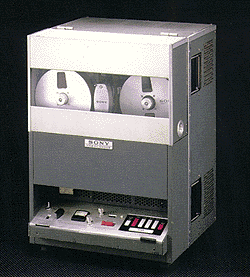
 professional use transistor-based videotape recorder, using a 1.5 head system leaded to it being lighter than the first design. First design weighed 200kg, the PV-100 weighed 60kg (big improvement)
KV-1310 (1968)
 The first in Sony's exclusive line of Trinitron colour TVs. This model gave about twice the brightness of televisions using conventional shadow mask tubes. This was a milestone product showing Sony's expertise in colour TVs


Japan's first tape recorders. this product had tape speed of 19cm per second. With Sony's exclusive small-hub reel, the machine accepted tapes in reel diameters of up to 10 inches. Units were delivered to the supreme court and various other government agencies, earning its nickname *Type- G* for government use only. A year later the Type-H was developed, which was for home use and also was a lot lighter than the Type-G.
TV8-301 (1960)

TV5-303 (1962)

(famous slogan: Transistors have changed TV)
PV-100 (1963)
KV-1310 (1968)

Tuesday, 28 February 2012
History of Sony research video
Very good source of research, the video explains some of Sonys major product releases and how and where they were manufactured.
1) 1950 first tape recorder in japan
2) 1955 first transistor radio (already researched)
3) 1960 worlds first transistor TV set
4) 1962 5 inch micro TV set
5) 1963 worlds first all transistor video corder
6) 1968 3 drawn colour TV (one of the most important products)
1) 1950 first tape recorder in japan
2) 1955 first transistor radio (already researched)
3) 1960 worlds first transistor TV set
4) 1962 5 inch micro TV set
5) 1963 worlds first all transistor video corder
6) 1968 3 drawn colour TV (one of the most important products)
History of Sony
History
In the beginning there was Tokyo Tsushin Kogyo K.K. (Tokyo Telecommunications Engineering Corporation) but to date it is known as Sony worldwide.
1945
Sony was originated in the late of 1945 just after the Second World War with a man called Masaru Ibuka who ran a radio repair shop in a half broken department store owned by Shirokiya (Japan’s largest retailer during early 20th century) which was in Nihonbashi of Tokyo. It started by repairing broken radios and manufacturing small numbers of voltmeters.
1946
As it came to May 7th 1946, Ibuka was joined by his colleague Akio Morita and Tokyo Tsushin Kogyo Kabushiki Kaisha was founded, the company started by building an automatic rice cooker
1950s
When it reached the 1950s Ibuka travelled to the United States and learnt of Bell Laboratories working on a transistor invention. He then persuaded Bell Labs and acquired the technologies licence to his Japanese company. While the United States was using the technology for other purposes, Ibuka and Morita wanted to use it with communications. American companies like Regency Electronics and Texas Instruments made the first transistor radio as a joint project, but it was actually Ibuka’s company that made transistor radio successful in the commercial business.
The first commercial transistor radio: the Sony TR-55 was released in 1955, although December of the same year they also released the Sony TR-72. This product favoured within Japan and other markets around the world like Canada, Australia, the Netherlands and Germany. Having six transistors, push/pull output and enhanced sound quality, the TR-72 carried on to be quite popular and was a bestseller through to the early 1960s.
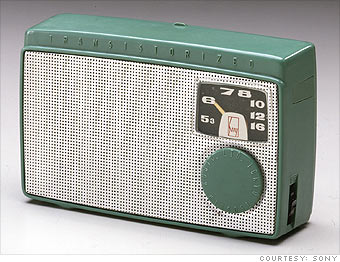
TR-55
May 1956, the company released a new design called the TR-6, that was slimmer and the sound quality was capable to matching portable tube radios.
Because of this piece of equipment Sony contracted Atchan, the cartoon character created by Fuyuhiko Okabe, which then became the companies advertisement character. The character finalised to then be known as Sony Boy, the cartoon advert to be shown with TR-6 being held to the characters ear. The character went on through to the mid sixties to represent the company with lots of other products.

TR-6
The Sony brand - which is a conflation of Sonus, the Latin word for sound and Sonny (as in ‘young boy’) - first appeared in 1955. Totsuko became Sony Corporation three years later.
WORLD OF TECH NEWS
By Rob Mead
April 24th 2008
Subscribe to:
Posts (Atom)